All Lessons and Resources
A Christmas Carol: Disability Informed Reading Guide
Image Description: “A Christmas Carol: Disability Informed Reading Guide” pale green background with black text. Simple black book with white pages graphic.
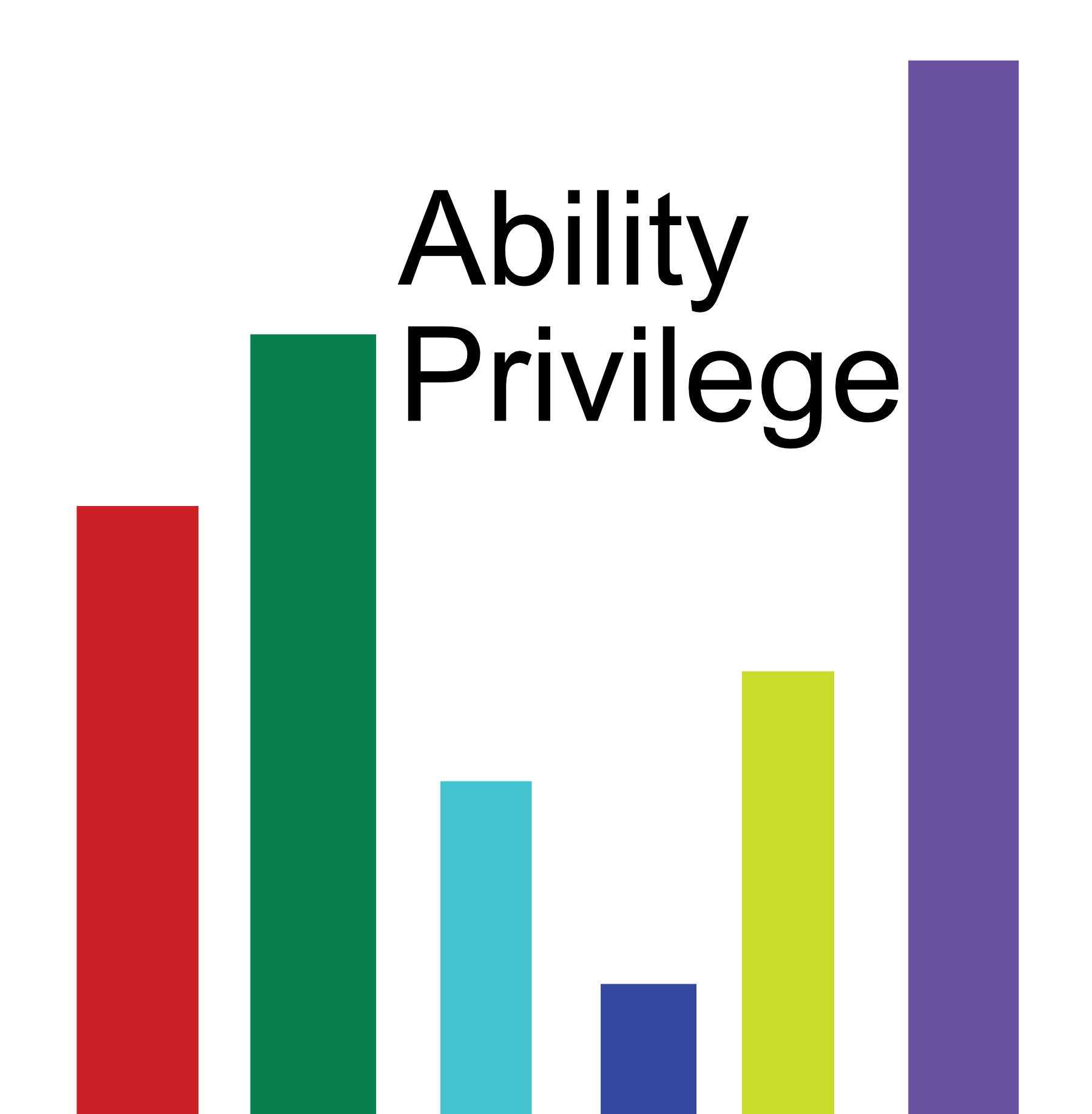
This activity is designed for students to reflect on their own lives and their privilege status. Unfortunately in our society certain groups can navigate with ease, while others must fight for their basic rights. Students will reflect on how their ability (able-bodied or disabled) affects their lives and how they can use their privilege to help others.
Image Description: various heights of different colored bars lined up next to one another. The words “Ability Privilege” towards the top.
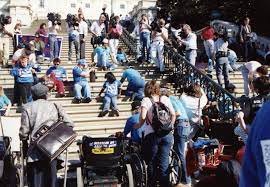
This lesson plan is a guide for how you can have a discussion with your students about the history of the ADA and, more specifically, the Capitol Crawl, which was a protest that was successful in urging congress to vote on the ADA. The lessons center around a 9 minute video that tells the story of the Capitol Crawl. There is a worksheet that goes with this lesson.
Image description: photograph of dozens of protesters on the steps of the Capitol building. Some are standing, some in wheelchairs, many are crawling up the steps.
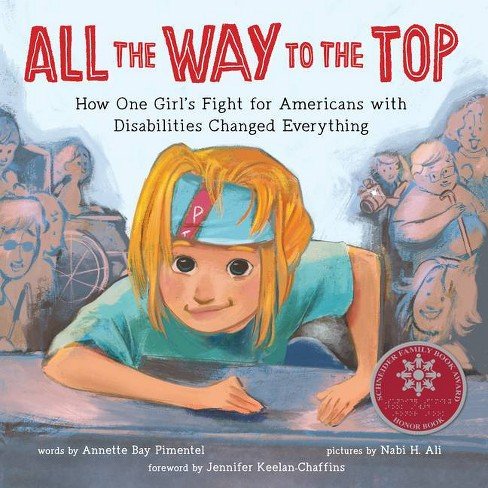
In this lesson students will learn new vocabulary words and explore important civil rights themes by reading the book “All the Way to the Top” by Annette Bay Pimentel. “All the Way to the Top” tells the childhood story of Jennifer Keelan-Chaffins, who climbed all the way to the top of the stairs of the US capitol in 1990 to encourage congress to pass the Americans with Disabilities Act (ADA). Jennifer has cerebral palsy and became famous for the photos taken of her while climbing the stairs without a wheelchair at just 8 years old. The book tells the story from her perspective and covers how she felt she was not treated equally in her community and how she and other activist worked to get the ADA passed.
Image description: Cover artwork for “All the Way to the Top”

This lesson will help students to analyze the theme of a poem. Students will compare their understanding of how they view disability before and after reading the poem. Students will compare the message and theme of the poem and contrast the bird in the poem to the life of a person with a disability.
Image Description: Chickadee sitting in a baseball hat

By analyzing various primary and secondary sources, students will determine how citizen activism among the disabled community led to passage of the Americans with Disabilities Act (ADA) in 1990. After reviewing ADA provisions that improved access to public facilities and the workplace, students will identify continued areas of need for people with disabilities and develop public service announcements that promote personal responsibility for maintaining accessibility.
Image Description: National History Day logo, “The Americans with Disabilities Act: Taking Action for Access,” and a series of 4 blue and white accessibility symbols arranged in a diamond pattern with “Americans with Disabilities Act” along the top edges.

This lesson details the provisions of the Americans with Disabilities Act signed by President George H.W. Bush. It also looks at the 20th Anniversary speech made by President Barack Obama and his vision for the future of Americans with Disabilities.
Image Description: C-SPAN Classroom logo, “Americans with Disabilities Act” and photo of the signing of the ADA

This is a lesson about Astrophysicist and Computer Scientist Dr. Wanda Diaz-Merced who is a blind scientist who studies the stars by listening to data converted into sound through a process called sonification.
Sonification is the use of non-speech audio to convey information or perceptualize data. To put it more simply, Sonification is the process of using sound to convey information or turning data into sound. Sometimes, sonification can convey more detailed information better than visual representation can.
Sighted and blind people use sonification to gather information. And blind people can use sonification to study the stars and the universe.
This lesson can supplement Science units about Sound, Space, or Technology. It can even be adapted to supplement Music lessons about pitch and tone.
Image Description: The image is a digital artwork featuring a black and white photo of a Wanda Diaz Merced, who is wearing a headset with a microphone and appears to be speaking. She is set against a colorful, abstract background that includes a large orange circle, a smaller yellow circle, and a blue brushstroke. There are also various abstract shapes and patterns, including dots and lines, scattered around the image. On the left side, vertically, it says "SONIFICATION OF STARS" and on the right side, horizontally, it reads "WANDA DIAZ MERCED" in yellow text.
Beauty and the Beast: Disability Informed Reading Guide
Image Description: “Beauty and the Beast: Disability Informed Reading Guide” pale blue background with black text. Simple black book with white pages graphic.
In this lesson, students will consider what accommodations they can make in order to be more inclusive of their peers with disabilities.
Image description: Photo of cake, birthday hats and Happy Birthday banner

Students will select a Black Disabled artist from Leroy Moore’s Black Disabled Art History 101. Students will research their selected artist and their works. Students will choose a piece of artwork created by this artist and analyze it using a critical artistic framework. This lesson can be adapted for a wide range of ages.
Image description: Cover photo of Black Disabled Art History 101
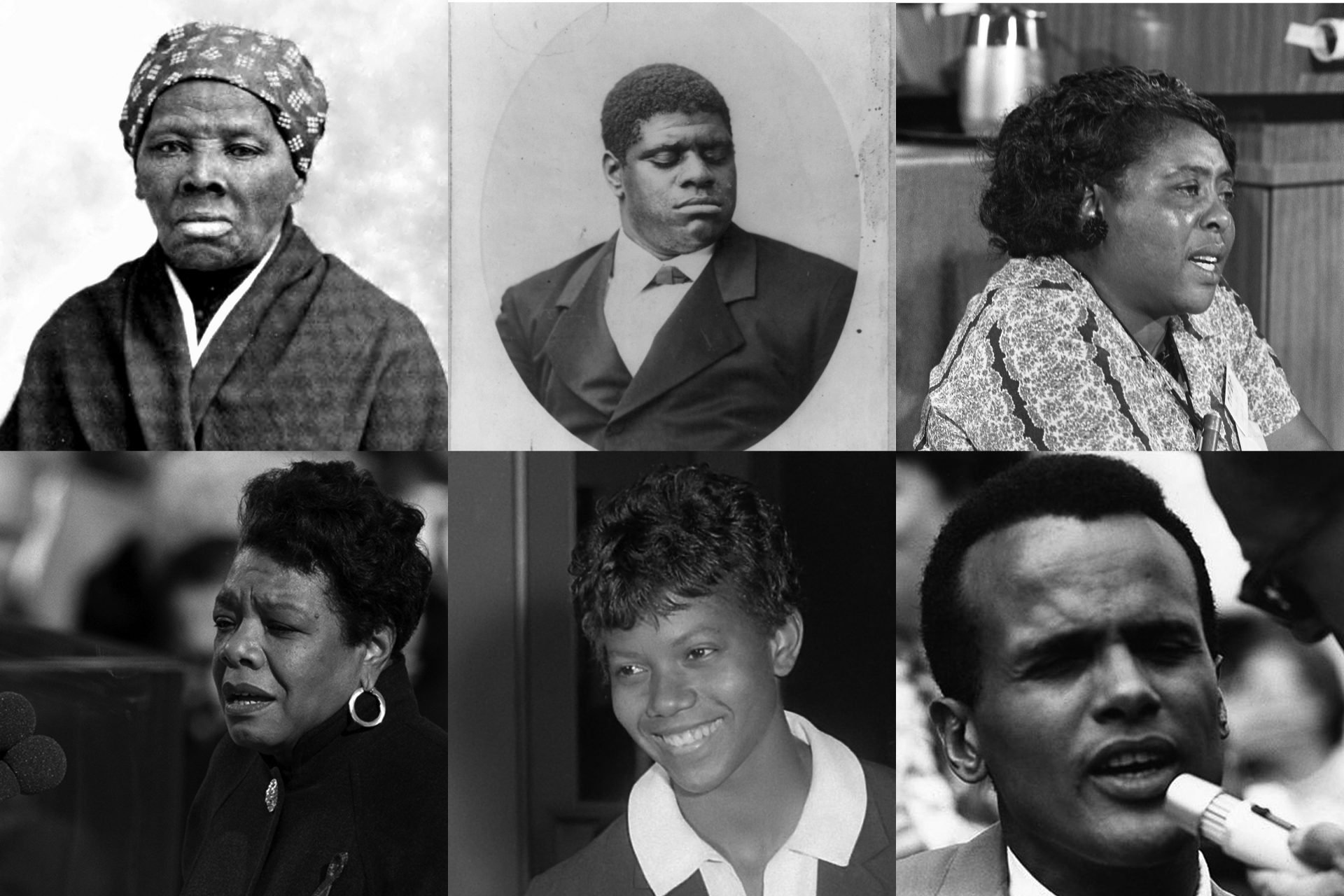
In this lesson, students will be invited to research a famous Black Disabled person, either from history or modern day. Students will work in groups or individually to research their assigned person and create a final project in a creative format. Students will then present their findings to the class.
Image description: Photos of 6 famous Black Disabled people: Harriet Tubman, Tom Wiggans, Fannie Lou Hamer, Maya Angelou, Wilma Rudolph, and Harry Belafonte
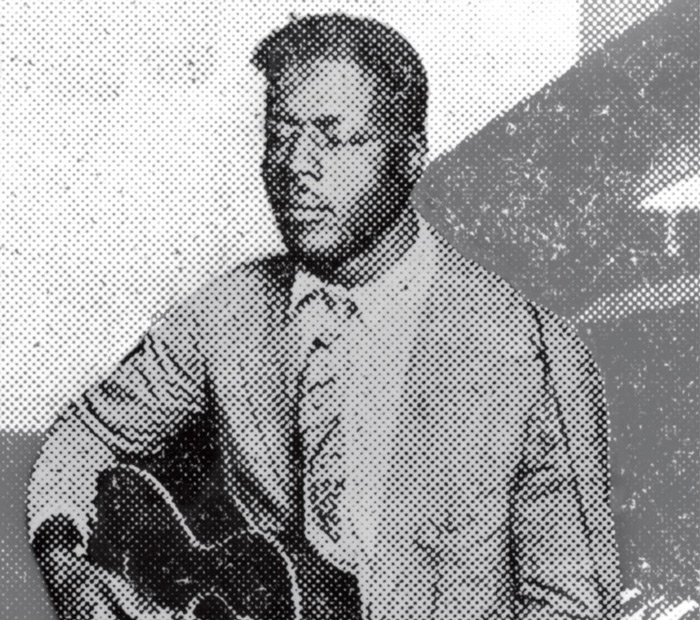
Students will learn about one of the most influential blues guitarists of the early 1900s, Blind Willie Johnson. They will read an article detailing his life and how he is remembered. The class will then listen to an example of his music, and covers of his music. Students will also discuss how blind musicians can help advance the discussion concerning the stigma of disability.
Image description: halftone photograph of Blind Willie Johnson

On the YouTube page linked you will find a playlist with dozens of read a loud videos of books that we believe will add opportunities to incorporate disability representation in natural, positive ways to your class.
Image description: colorful books on a dark bookcase

Students identify with each other some things they like and pass around a ball of twine. The twine represents a web and every student will be holding a part of it to keep it strong. Students will reflect on their own webs in their lives and create their own webs using crafting materials.
Image description: spider web

In this lesson, students complete grade-appropriate math problems using facts and figures from Rick Hansen’s Man In Motion World Tour. Students will examine mathematical problems evolving out of the day-to-day challenges of Rick Hansen’s Man In Motion World Tour. Students will apply multiplication and division skills to real-life math problems. Students will apply conversion skills to real-life math problems.
Image Description: Logo of Rick Hansen Foundation.

A calendar of events that recognizes various days (and months) is an easy way to bring the conversation about disability into your classrooms and schools. Including discussion of disabled people throughout the year sends a message to all that disabled students are recognized and valued as a part of the education community.
Image description: calendar page tilted at an angle, reading glasses rest on the bottom corner of the calendar
The Catcher in the Rye: Disability Informed Reading Guide
Image Description: “The Catcher in the Rye: Disability Informed Reading Guide” pale blue background with black text. Simple black book with white pages graphic.

Students will participate in an exercise and discussion on disability and segregation. In this lesson students will map out social interactions in their everyday lives. After they complete the exercise the teacher will facilitate a discussion on segregation. Students with disabilities who grow up in institutions are effectively segregated from the rest of the population, so their social circles tend to look very different from the students in class. This lesson is split into two class periods.
Image description: Overlapping circles with various disability icons inside each circle

This lesson will use wheelchair wheels to teach the concept of circles. Students will identify circles in wheelchair wheels and then draw/sculpt their own.
Image description: 2 wheelchairs and 4 circles
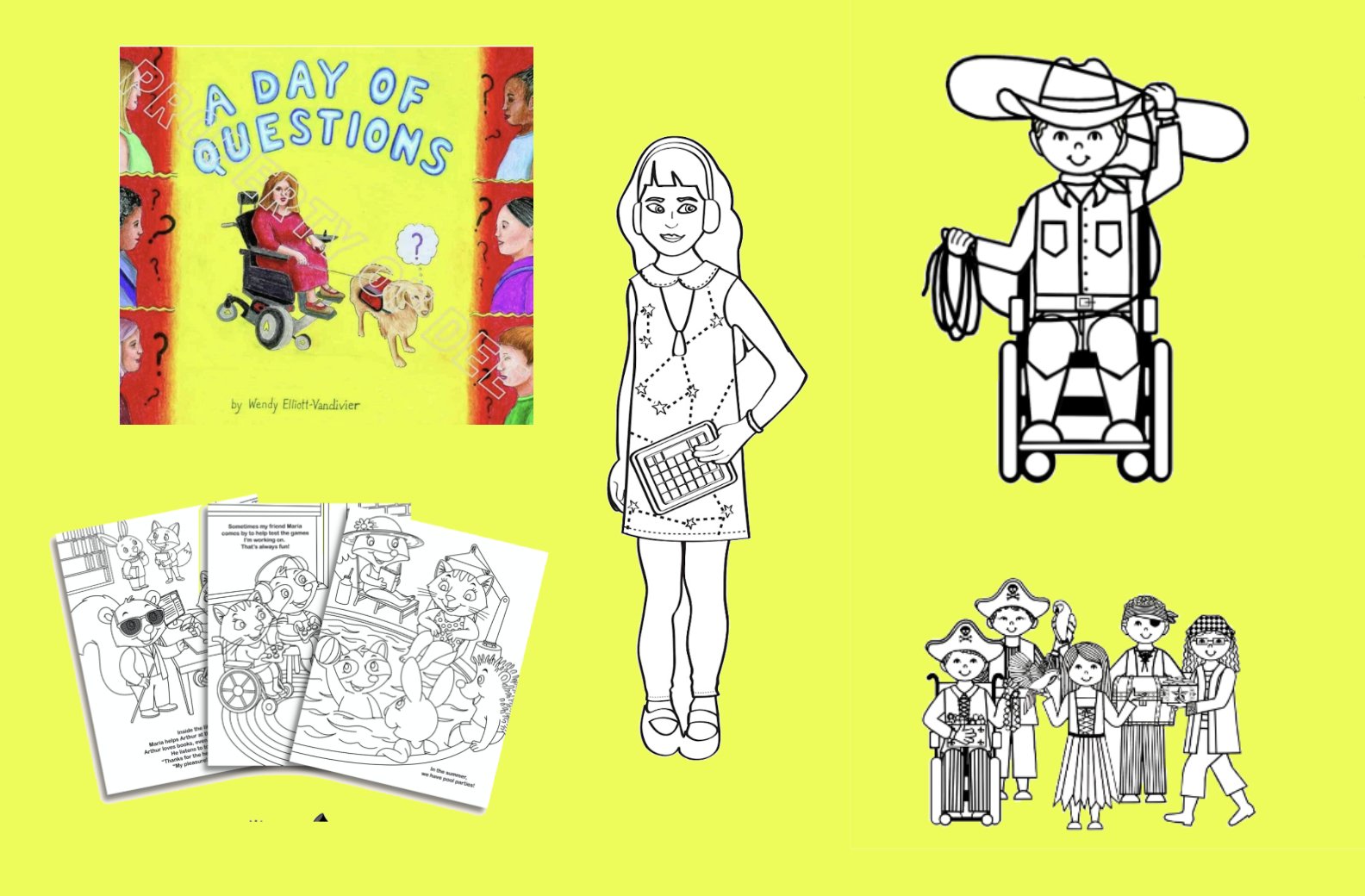
Including coloring pages and artwork in lessons (some of these allow you to use as clip art) that includes disability representation furthers the goal of regularizing disability by seeing it and offering opportunities to learn and ask questions.
Image Description: small images of the coloring books on a yellow background

Students will participate in an interactive read-aloud and discussion of the picture book “Come Over to My House” by Eliza Hull and Sally Rippin, exploring its representation of disabilities. They will respond to a writing prompt inspired by the book and create artwork to accompany their writing. The lesson concludes with reflective questions and optional follow-up activities to address student inquiries.
Image Description: Cover of a children's book titled "Come Over to My House." It features a group of children and a dog and 2 adults at an open door. One child is in a wheelchair, another is upside down, and there is a dog sitting in the middle. The children are smiling and appear welcoming.

In this opinion piece, students will learn about one teenager’s perspective on the value of social media, especially for people with disabilities. Students will analyze the author’s point of view about social media.
Image Description: Logo of CommonLit which looks like an open book with a colorful image of assorted figures with a black silhouette of a person in front

In this text, students will learn about how video games are being adapted to meet the needs of players with disabilities. Students will practice analyzing text structures. They will understand how paragraphs build on one another and how authors organize their writing using specific text structures such as subheadings.
Image Description: Logo of CommonLit, which looks like an open book at the top, with an image of a student and 3 computer screens against a blue curtain
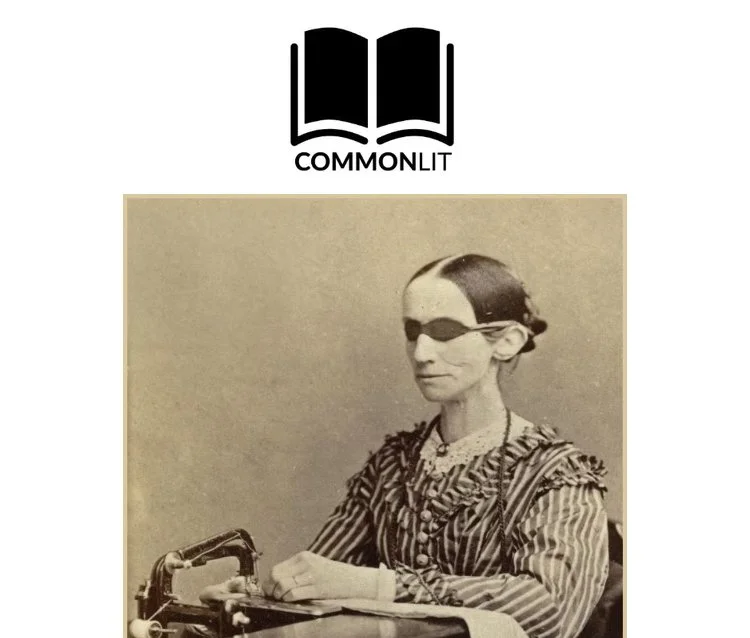
Students read an informational text about Laura Bridgman, the first deaf-blind person to learn to read and write a language, and explore how she developed her own ways of communicating and learning before and after attending the Perkins Institution. Through reading and discussion, students consider how access to education shapes what people are able to do, and what assumptions about disability can get in the way of that access.
Image Description: Logo of CommonLit, which looks like an open book with a sepia tone photo of Laura Bridgman at a sewing machine
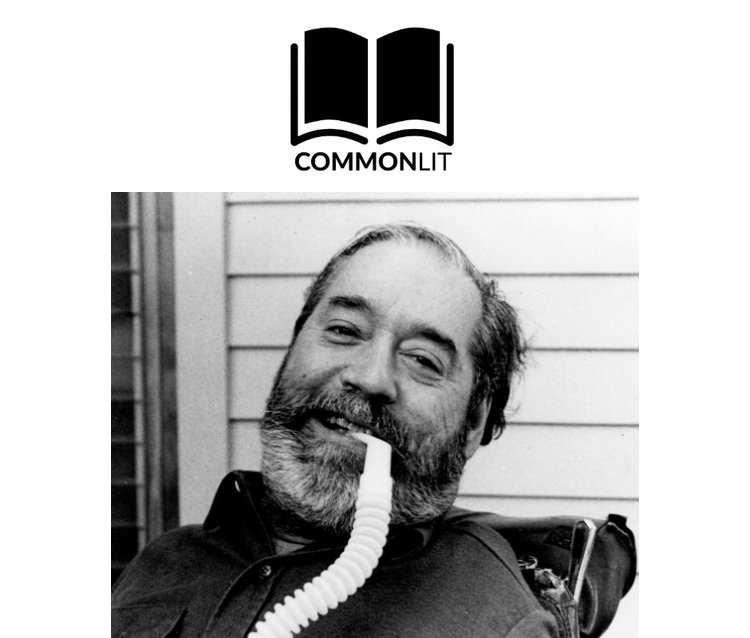
Students read a compilation of speeches by Ed Roberts, a disability rights activist and organizer, and examine how he uses personal narrative, humor, and argument to make the case for disabled people's autonomy, access, and civil rights. Through reading and discussion, students analyze Roberts' rhetorical choices and consider how individuals and communities build power to challenge systemic barriers.
Image Description: Logo of CommonLit, which looks like an open book with a photo of Ed Roberts with his breathing tube in his mouth
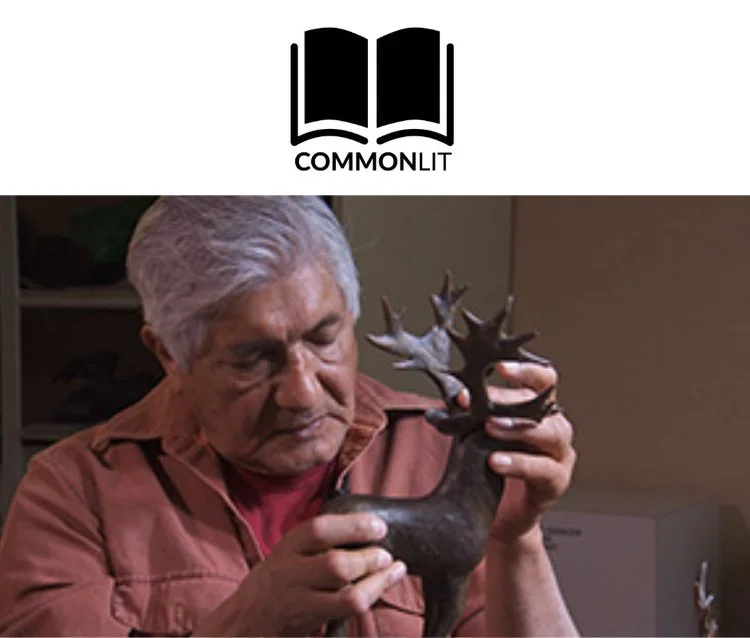
Students read a biographical profile of Michael Naranjo, a Tewa sculptor who is blind, and explore how his artistic practice is rooted in memory, touch, and a lifelong connection to his community and culture. Through reading and discussion, students consider what it means to express yourself through art and how Naranjo's work connects to his identity as a Native American artist and Vietnam veteran
Image Description: Logo of CommonLit, which looks like an open book with a photo of Michael Naranjo holding a sculpture of a horned animal in his hands
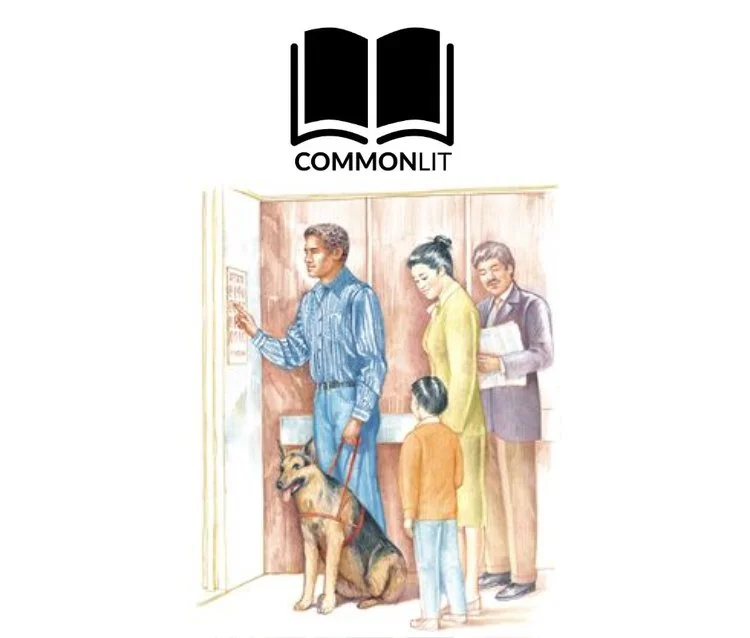
Students read a short biographical text about Louis Braille and explore how he developed a tactile reading and writing system that became a tool for access used around the world. Through reading and discussion, students consider how barriers to literacy shaped Braille's innovations and how those innovations continue to open doors for blind and low-vision communities today.
Image Description: Logo of CommonLit, which looks like an open book with a drawing of a person with his guide dog and 3 other people in an elevator

In this text, students learn about the experiences of people with disabilities in college and the actions that can be taken to create more inclusive campuses. Students practice finding the main ideas of each paragraph or section and then the article’s overall central idea.
Image Description: Logo of CommonLit which looks like an open book on top with a photo of a student seated in a wheelchair in a large stadium seating classroom

In this lesson students will contemplate how they perceive disability and explore stereotypes and misconceptions of disability through a circle discussion activity. This lesson is intended as an introductory activity on disability. Students are just beginning the discussion on disability.
Image description: rainbow concentric circles