Disability Art or Disability Arts is any art, theatre, fine arts, film, writing, music or club that takes disability as its theme or whose context relates to disability.
On this page we will introduce you to the Disability Arts projects that were designed for students K - 12 by disabled artists. Educators will find a sample of the artwork designed for a specific age group, information about the artist that designed the work, a link to a short video about the artist and their journey to creating the artwork, and 3 lesson plans created by an educator for you to use, or to help you create your own.
Are you interested in teaching Disability Arts?
Would you like to teach this in your classroom/school?
Would you like artwork for your classroom?
Would you like to have a Disability Arts Show?
Learn more here!
While the four Artists defined a particular grade range to work with, the four artists as a collective could be studied at the high school level on a unit on disability artists and how they create work in different mediums. Each artist has also created a video explaining their work and their journey. Reach out for more information.
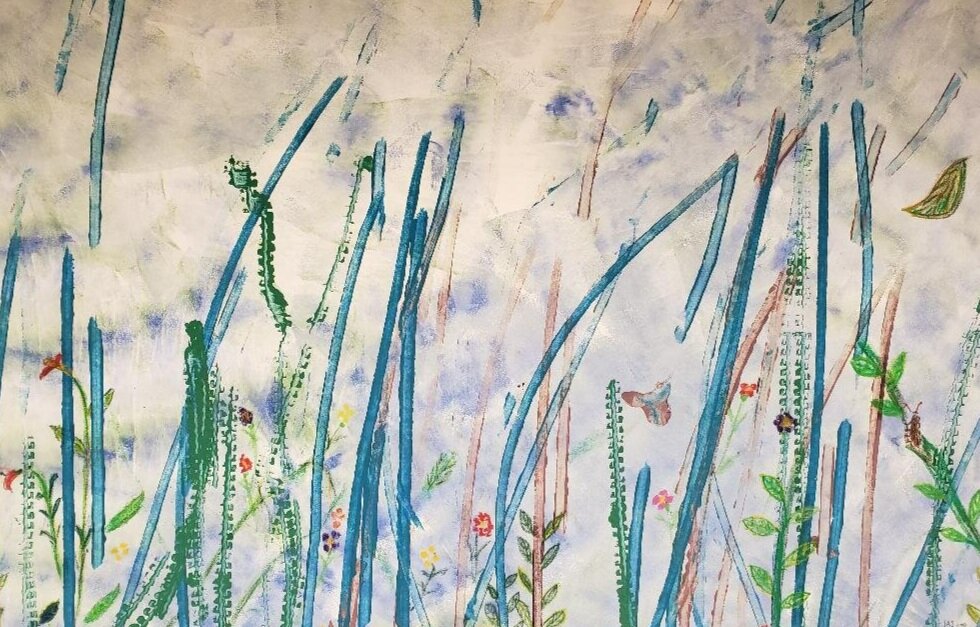
{Image description: Abstract ‘Wildflowers’ painting of inclusive art made with wheelchair wheels, cane tips, and other things}
Image by Liberty Resources Art Studio members and staff.
Disability Arts Lesson Plans
Students will select a Black Disabled artist from Leroy Moore’s Black Disabled Art History 101. Students will research their selected artist and their works. Students will choose a piece of artwork created by this artist and analyze it using a critical artistic framework. This lesson can be adapted for a wide range of ages.
Image description: Cover photo of Black Disabled Art History 101
Disability and Disability Arts - Physical Disability and Accessibility- Coloring Book - “A Day of Questions”
This is a three part lesson to introduce the student to disability and a disabled artist's work. Disability arts is an art form where the context of the art takes on disability as its theme. Disability art is about exploring the various realities of what it's like to be disabled. The theme of disability may be used in a variety of ways in how the artist chooses to represent the theme in their work. This lesson uses a coloring book created by Wendy Elliot Vandivier.
Image Description: Cover artwork for the book “A Day of Questions” by Wendy Elliot-Vandivier. The background is yellow and has a drawing of a woman in a read dress with shoulder length red hair sitting in a motorized wheelchair with a service dog wearing a red vest in front of her with a question mark over the dogs head. There are 6 illustrations of children on each side of the cover facing the center with question marks in the background.
Lesson title: Disability and Disability Arts - Disability and Disability Arts Invisible Disabilities/ Autism/Poetry/ Golden Shovels Poetic Form
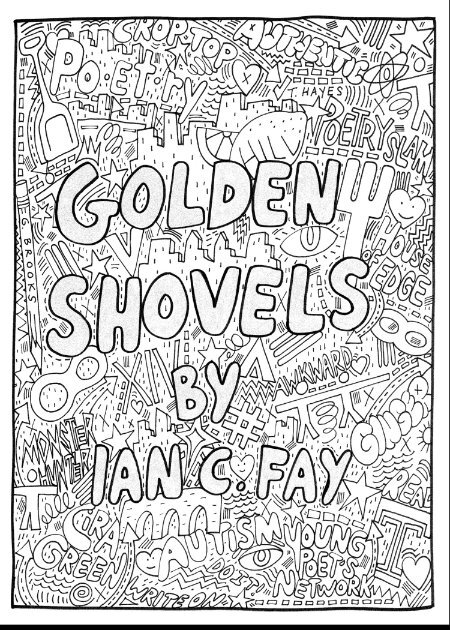
This is a three part lesson to introduce the student to disability and a disabled artist's work. Disability arts is an art form where the context of the art takes on disability as its theme. Disability art is about exploring the various realities of what it's like to be disabled. The theme of disability may be used in a variety of ways in how the artist chooses to represent the theme in their work. This lesson uses poetry created by Ian Fay.
Image Description: black and white illustration with the title “Golden Shovels by Ian C. Fay” in bold open letters. The background is filled with dense, intricate doodle pattern.
Disability and Disability Arts - Invisible Disabilities - “See Me; Invisibility” Paintings Lessons
This is a three part lesson to introduce the student to disability and a disabled artist's work. Disability arts is an art form where the context of the art takes on disability as its theme. Disability art is about exploring the various realities of what it's like to be disabled. The theme of disability may be used in a variety of ways in how the artist chooses to represent the theme in their work. This lesson uses 3 paintings created by Mali Fenning.
Image Description: 3 paintings by Mali Fenning. Left artwork features geometric shapes and a dark color palette. Top right art features a colorful face with red lips and curly hair. The bottom right artwork has wavy lines and circular shapes in a mix of colors.
Disability and Disability Arts Vision Loss - Disability Empowerment “Disability Looks Like You and Me”
This is a three part lesson to introduce the student to disability and a disabled artist's work. Disability arts is an art form where the context of the art takes on disability as its theme. Disability art is about exploring the various realities of what it's like to be disabled. The theme of disability may be used in a variety of ways in how the artist chooses to represent the theme in their work. This lesson uses art created by Jade Ramos.
Image description: A colorful abstract artwork featuring a silhouette of a person with long hair outlined in bright neon colors. The background is filled with vibrant, swirling patterns. Text says “Every One Matters, Even You” along the left and right edges. The person is wearing a shirt with the text “Disability Looks Like You and Me”
Disability Arts Examples
-
'A Day of Questions' Coloring Book
In K-2, artist Wendy Elliot-Vandivier has created a coloring book entitled “A Day of Questions”. Wendy is a wheelchair user and has a service animal. In the book different students ask Wendy how she goes about daily activities and tasks in her life. Through her drawings and text Wendy shows the student how she does the activities and tasks.
Wendy uses pencil and pen and ink to complete her work. She has created pictures of herself in activities for the students to color.
{Image description: A female wheelchair user Wendy, with red hair and dress, with a tan service animal on a leash. On both sides are a diverse set of three children with question marks looking at Wendy}
Image by Wendy Elliott-Vandivier
-
Disability Looks Like You and Me
In grades 6-8, artist Jade Ramos has created several works that include graphics and sentences that show disability inclusion entitled “Disability Looks Like You and Me”. Jade uses bright colors layers on top of one another and words with different kinds of spacings to create disability inclusion and empowerment messages. In Jade’s video they discuss their disability of being legally blind and their process to make art with their disability. Jade's work can easily be used for the other grades as well. This body of work works well in the PA standards for arts and humanities and also in Language arts.
{Image description: Multicolored neon graphic background with large black words around edges, Everyone Matters Even You. In center is a person with long golden hair in black tee with words and short skirt. She has a left arm limb difference and left leg prosthetic}
Image by Jade Ramos
-
See Me; Invisibility
In Grades 9-12, artist Mali Fenning, has created three paintings that reflect her experience with her disability. Mali is diagnosed with Obsessive Compulsive Disorder and neurodivergent as a young adult.
Mali uses bright colors, layers of paint and different forms in her paintings. In her video she discusses how she navigates life with her disability and goes through each of her paintings and what the forms and layers represent.
{Image description: Painting in dark blues, greens, yellows, and whites. Images of boxes falling down right side and faces on left hidden and masked}
Images by Mali Fenning
-
Golden Shovels Poetry
For grades 9-12, artist Ian Fey created a series of five Golden Shovel poems in a workbook for students. Ian has autism and he uses a form of poetry called Golden shovels created by poet Terrance Hayes. The lines that he uses in his poems come from the Autism Speaks' AD called “I am Autism”.
He explains in his video why he uses those lines in his video. Ian does a reading of his five poems in the video.
{Image description: White background with black graphics of words and images that reflect Ian and the things he loves. In gold words, Golden Shovels by Ian C. Fay in large letters across image}
Image by Natalie Hope McDonald
More Arts Lessons
This is a lesson about Astrophysicist and Computer Scientist Dr. Wanda Diaz-Merced who is a blind scientist who studies the stars by listening to data converted into sound through a process called sonification.
Sonification is the use of non-speech audio to convey information or perceptualize data. To put it more simply, Sonification is the process of using sound to convey information or turning data into sound. Sometimes, sonification can convey more detailed information better than visual representation can.
Sighted and blind people use sonification to gather information. And blind people can use sonification to study the stars and the universe.
This lesson can supplement Science units about Sound, Space, or Technology. It can even be adapted to supplement Music lessons about pitch and tone.
Image Description: The image is a digital artwork featuring a black and white photo of a Wanda Diaz Merced, who is wearing a headset with a microphone and appears to be speaking. She is set against a colorful, abstract background that includes a large orange circle, a smaller yellow circle, and a blue brushstroke. There are also various abstract shapes and patterns, including dots and lines, scattered around the image. On the left side, vertically, it says "SONIFICATION OF STARS" and on the right side, horizontally, it reads "WANDA DIAZ MERCED" in yellow text.
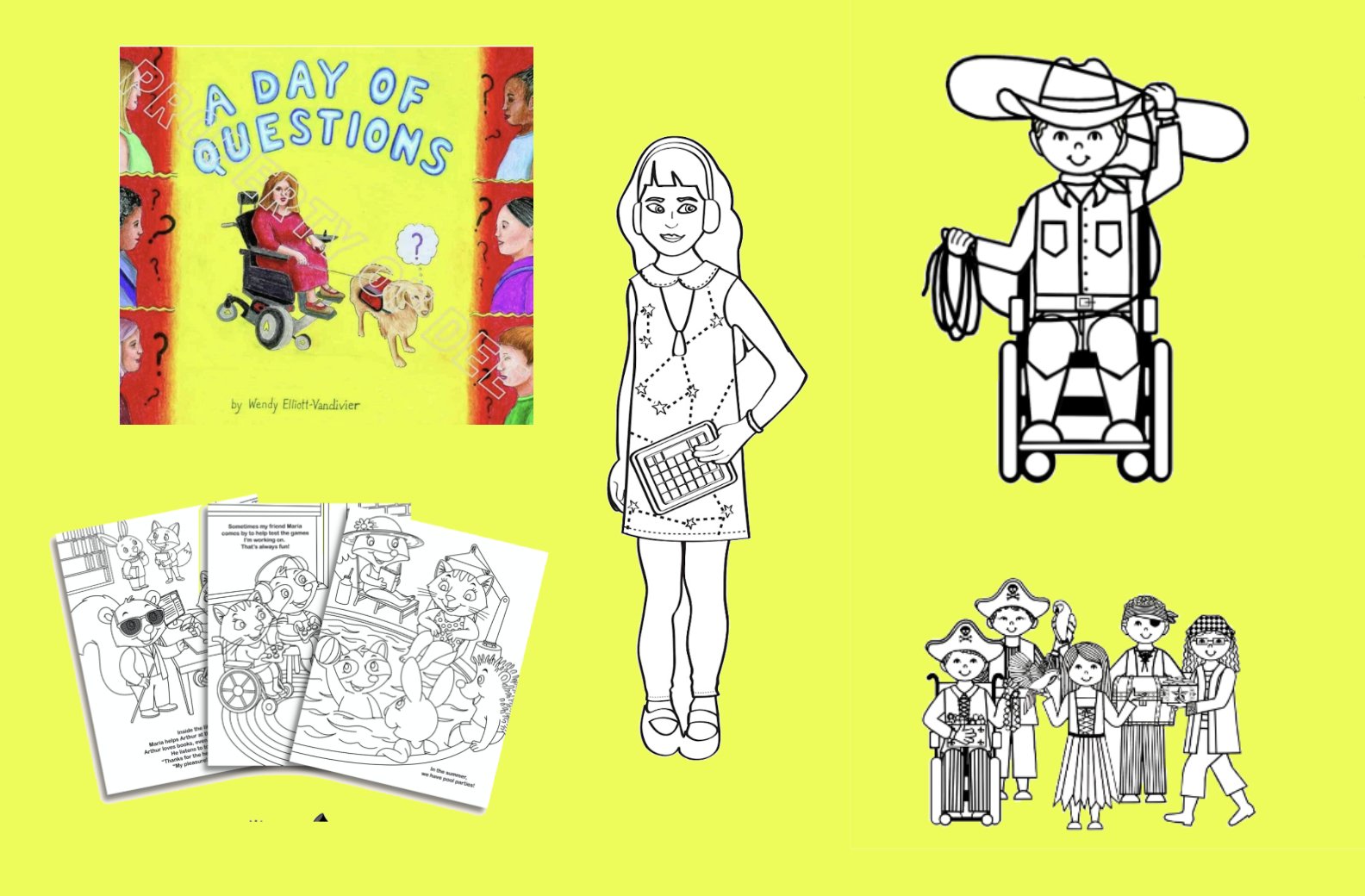
Including coloring pages and artwork in lessons (some of these allow you to use as clip art) that includes disability representation furthers the goal of regularizing disability by seeing it and offering opportunities to learn and ask questions.
Image Description: small images of the coloring books on a yellow background
Students will explore problem-solving by learning how scientist Joshua Miele and ballerina Krishna Washburn overcame challenges. They will then create their own invention - either practical or imaginative - through drawing, writing, or crafting a model. Afterward, they will be paired with a student interviewer who will either conduct a class interview or write a news article about their invention.
Image Description: “Creative Problem Solving with Joshua Miele and Krishna Washburn” in black text on a medium to light blue rectangle. The background of the image is a few dozen black question marks in various fonts, sizes and angles
Summary:
In this lesson, students will look at four different characterizations of autistic children in contemporary media. They will watch excerpts or videos featuring the characters, read about the characters, and study how they were created. They will then fill out an evaluation chart to analyze the different depictions. They will have a group discussion as a class and write a reflective response.
Issues considered will include: character’s role within the show/movie; who was involved in writing/creating the characters; what public response has been; and so on. The lesson will conclude with a group discussion and students will complete a journal-style piece of writing as an exit ticket.
The characters that the students will learn about are:
Julia from the television show Sesame Street;
Pablo from the television show Pablo;
the main character from a Pixar short called Loop;
Carl, from the show Carl the Collector.
Image Description: Upper left quadrant is Julia, a muppet with yellow skin and orange hair. Upper right quadrant shows the main character from Loop, a girl with brown skin and dark hair who is reaching with her hands to touch reeds. Bottom left quadrant shows Pablo, a hand-drawn boy with light skin standing on a green hill with a rainbow behind him. Bottom right quadrant shows Carl, an illustrated raccoon wearing an argyle sweater.
This unit focuses on the historical event that caused a ripple in the Deaf community, Deaf President Now. The unit includes three lessons, three projects, and a lot of fun!
Image Description: Black and white photo of students holding a banner that says “Deaf Prez Now!”.
In this lesson, students will learn about data art, an art form that takes scientific or mathematical data and translates it into a visual art form such as a painting, drawing or sculpture. Using disability related statistical data from provided sources, they will create their own piece of data art. The students will also write short reflections on the artwork that they create. This lesson can function both as a standalone art exercise, or may be a useful closing exercise for a unit in math or science that focuses on statistics.
Image Description: Text at top of image in white says “Disability Data Art”. Image with a water like teal and pale yellow background and assorted shapes in various colors from the previous chart overlaid on the background.
Disability and Disability Arts - Physical Disability and Accessibility- Coloring Book - “A Day of Questions”
This is a three part lesson to introduce the student to disability and a disabled artist's work. Disability arts is an art form where the context of the art takes on disability as its theme. Disability art is about exploring the various realities of what it's like to be disabled. The theme of disability may be used in a variety of ways in how the artist chooses to represent the theme in their work. This lesson uses a coloring book created by Wendy Elliot Vandivier.
Image Description: Cover artwork for the book “A Day of Questions” by Wendy Elliot-Vandivier. The background is yellow and has a drawing of a woman in a read dress with shoulder length red hair sitting in a motorized wheelchair with a service dog wearing a red vest in front of her with a question mark over the dogs head. There are 6 illustrations of children on each side of the cover facing the center with question marks in the background.
Lesson title: Disability and Disability Arts - Disability and Disability Arts Invisible Disabilities/ Autism/Poetry/ Golden Shovels Poetic Form
This is a three part lesson to introduce the student to disability and a disabled artist's work. Disability arts is an art form where the context of the art takes on disability as its theme. Disability art is about exploring the various realities of what it's like to be disabled. The theme of disability may be used in a variety of ways in how the artist chooses to represent the theme in their work. This lesson uses poetry created by Ian Fay.
Image Description: black and white illustration with the title “Golden Shovels by Ian C. Fay” in bold open letters. The background is filled with dense, intricate doodle pattern.
Disability and Disability Arts - Invisible Disabilities - “See Me; Invisibility” Paintings Lessons
This is a three part lesson to introduce the student to disability and a disabled artist's work. Disability arts is an art form where the context of the art takes on disability as its theme. Disability art is about exploring the various realities of what it's like to be disabled. The theme of disability may be used in a variety of ways in how the artist chooses to represent the theme in their work. This lesson uses 3 paintings created by Mali Fenning.
Image Description: 3 paintings by Mali Fenning. Left artwork features geometric shapes and a dark color palette. Top right art features a colorful face with red lips and curly hair. The bottom right artwork has wavy lines and circular shapes in a mix of colors.
Disability and Disability Arts Vision Loss - Disability Empowerment “Disability Looks Like You and Me”
This is a three part lesson to introduce the student to disability and a disabled artist's work. Disability arts is an art form where the context of the art takes on disability as its theme. Disability art is about exploring the various realities of what it's like to be disabled. The theme of disability may be used in a variety of ways in how the artist chooses to represent the theme in their work. This lesson uses art created by Jade Ramos.
Image description: A colorful abstract artwork featuring a silhouette of a person with long hair outlined in bright neon colors. The background is filled with vibrant, swirling patterns. Text says “Every One Matters, Even You” along the left and right edges. The person is wearing a shirt with the text “Disability Looks Like You and Me”
In this lesson, students will be exposed to the artwork of Stephen Wiltshire. Wiltshire is from Britain and known for his large-scale detailed drawings of cityscapes. After learning about Wiltshire, who is autistic, students will have the opportunity to draw their own cityscape, inspired by Wiltshire’s art. For an extra geographic element, they can write facts about their city and create a bulletin board display. They will also consider how Wiltshire is often most widely described as a savant/genius, and how these words can create challenging stereotypes, both for the autistic community and for artists. For both, these words set up unrealistic expectations about who autistic people are/can be, and what art is/can be/how much training and practice is required to be an artist.
Image Description: Photo from behind a person wearing a dark jacket and a cap with headphones that is drawing on a large, detailed cityscape illustration. The drawing appears to be a bird's-eye view of a city with numerous buildings and streets.
Students will review the social model of disability and then apply it to 4 short films created for the Easterseals Disability Film Challenge. “The Easterseals Disability Film Challenge gives filmmakers—with and without disabilities—the opportunity to collaborate to tell unique stories that showcase disability in its many forms (disabilityfilmchallenge.com).” Students will watch the 4 winning films, and then break into groups to focus on analyzing one film as a group.
In this lesson, students will learn about the paintings of Mary Duffy, a multidisciplinary artist from Ireland. Mary paints expressive landscapes, often inspired by the seashores. In this lesson, students will review her paintings, and be invited to create 2 pieces of artwork inspired by different elements of Mary Duffy’s practice. One will be done in the classroom, and a second will be done in nature, with direct observation (this may be assigned as homework, depending on the weather). Students will also be invited to reflect about issues of accessibility related to nature exploration and disabled people.
Image Description: A photo of Mary Duffy painting a canvas at the beach. She is seated, wearing a red dress, using her feet to paint the canvas in front of her on a short easel. The text “Expressive Landscapes: The Art of Mary Duffy” is at the top of the image.
In this lesson, students will learn about the art of Maud Lewis, a prolific Canadian folk artist who lived in rural Nova Scotia (Eastern Canada, near the Atlantic Ocean), and worked in the mid-20th century. She is now believed to have been born with juvenile rheumatoid arthritis, but it was not diagnosed or treated in her lifetime. Students will learn about her artwork, rooted deeply in the place where she lived, and have the opportunity to keep a sketchbook for a week, and create a painting in Maud Lewis’ style that reflects their own local world. Students will also consider the complex intersections between disability, poverty and the arts that are embedded in Maud’s life story.
Image Description: a painted clam shell that features a red birdhouse in the center, surrounded by colorful flowers and two blue birds on either side. The shell is mounted on a wooden background. The artist's name, "Maud Lewis," is visible on the shell.
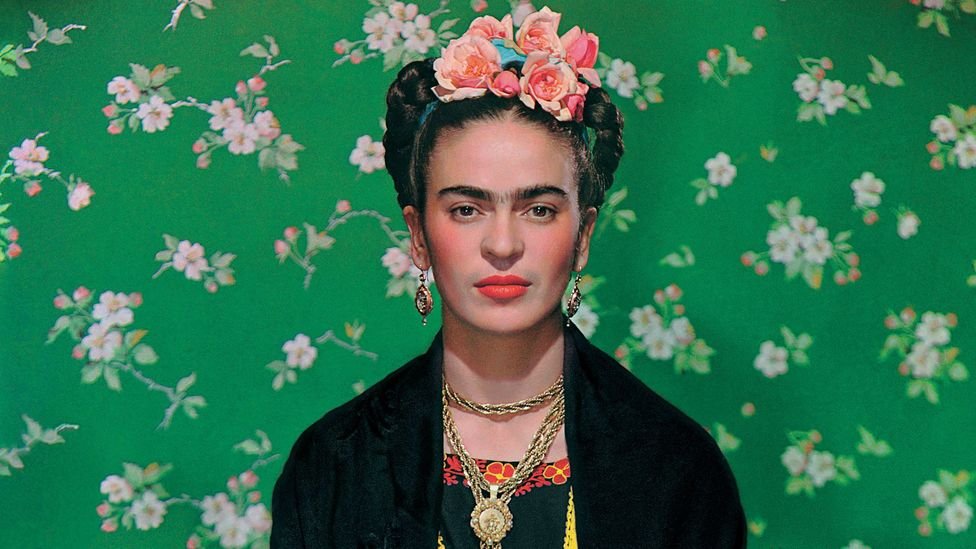
Frida Kahlo (1907 - 1954) was a Mexican artist who was influenced by the Mexican Revolution. She experienced a disability at two times in her life. Her determinism helped her cope with the pain of overcoming polio, a difficult marriage and bus-trolley accident. Frida Kahlo’s curiosity and love for nature were often the subjects of her paintings. Known as the “mother of the selfie,” Frida also created more than 200 paintings of herself. This unit of lessons is to recognize the creativity and imagination of Frida Kahlo.
Image description: Photograph of Frida Kahlo against a green floral background
In this lesson, students will learn about the paintings of Yayoi Kusama, an artist from Japan who is world-renowned for her immersive rooms and graphic paintings. Kusama lives in a supportive facility for people who live with psychiatric conditions, and has done so since the 1970s; the exact nature of her mental health support needs has not been disclosed to the public, but she has described experiencing hallucinations, anxiety, and pain in interviews. As part of this lesson, students will learn about different housing types for people of all abilities. Students will also be able to create either a painting or an infinity room (assignment can vary depending on your classroom materials).
Image Description: A large pumpkin sculpture sits on the grass, yellow and covered in vertical rows of black polka dots in varying sizes
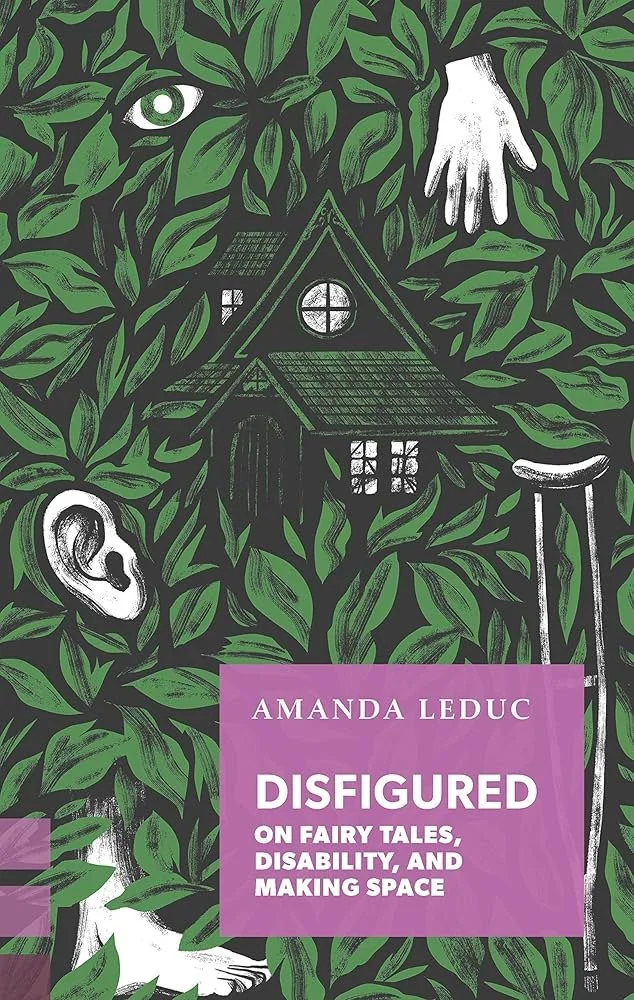
Using Amanda Leduc’s book “Disfigured: On Fairy Tales, Disability, and Making Space,” as inspiration students will consider different representations of disability in fairy tales and classic stories. They will watch an interview and a reading with Leduc, read 2 texts referenced in her book and learn to identify issues with how disabled people are presented and stereotyped. Students will produce two written assignments. One is an update to a classic story (either Beauty and the Beast or the Little Mermaid); the students will rewrite the classic tale to center and honor experiences of all bodies and abilities. The second assignment is a choice assignment. Students will either rewrite a second tale, or write a 1 page autobiographical story in the style of a fairy tale.
Image Description: The cover of the book “Disfigured: On Fairy Tales, Disability, and Making Space” by Amanda Leduc
Students will consider the icon of the person in a wheelchair, the “International Symbol of Access.” They will learn about its history and the recent Accessibility Icon project that updated it. They will also consider other disability symbols, both in the US and internationally (such as symbols that indicate Deafness, Hidden Disabilities, and Autism, and how they are used/not used in other countries).
Art extensions include photography assignments to document iconography in their school and in everyday life and new symbol-making where students make new symbols that could replace the wheelchair, and be more inclusive.
Geography extension is a study of symbols and use/news about them in other countries. Students will be assigned a country to study either individually or in groups, and explore disability iconography in that place. This activity would work well as a library-based extension as well.
Image Description: a white and blue reserved parking sign with a traditional wheelchair accessible symbol and a clear backed sticker of the new Accessible Icon in red pasted over it.
In this lesson, students will learn about alt text, and image descriptions that help people who have low vision or are blind to use the internet. Then, they will practice using the feature.
Image Description: "The Learning Network Teaching & Learning with the New York Times" Below the text is the Mona Lisa with 3 examples of alt text descriptions from Microsoft Word, Facebook and Wikipedia.
When Stephen Hawking passed away, many artists processed the loss through art. Their art depicts disability from multiple perspectives. In this activity students will explore 2 contrasting images. Take note of the details and how the images depict Stephen Hawking and his physical disability. Both of the images are from Twitter and students may have already seen both of the images just scrolling through their phones. Students will explore elements of art, social studies and psychology in this lesson. The focus of the discussion is up to individual educators.
Image description: illustration of Stephen Hawking, seated in his motorized wheelchair, floating above the earth with other planets in the background
By experimenting with stenciling, one technique Eref Aramagan uses to create his Art, the student will become aware of a way by which visual art can be created by use of touch.
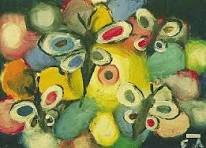
Image Description: Painting of brightly colored butterflies made using stencils by Eref Aramagan
In this lesson students will read a 2-page graphic novel format story about the Gang of 19 and “We Will Ride” action, and how they fought for equal rights for the disabled.
Image Description: Graphic Novel cover showing protesters in purple black and off white on a green background with the title “Colorful History Comics #31 We Will Ride” underneath the comic.
In addition to the lesson plans and resources above…
We have other programs and resources to help you grow the conversations about disability in your classroom and throughout the school.
In order to support you as you use the resources found here as well as others you may come across, or those you create yourself, we offer a variety of ways to get that support and training including our Membership Area and Professional Development in both live, customized as well as on-demand offerings
Be sure to check out our collection of other educational resources that we encourage you to explore and use in your classes as well.